Using Raw API
This method is the most flexible way to make a MixPay payment.
It's suitable for scenarios that can not use a browser, such as the Mobile Native App.
Please note using raw API is deprecated. Please using one time payment and our checkout page in the production.
Constructing the accept payment view
When a customer makes a purchase, on your App check-out page, show a "Pay with Crypto" button. When the customer clicks the button, you should construct an App view like our MixPay payment page.
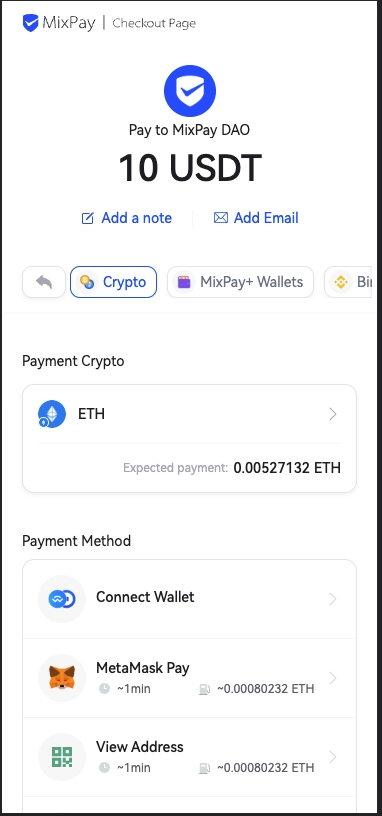
In this view:
- Using Quote Assets API to fetch the price in any supported cryptocurrency;
- Using Payment Assets API to let customers select which cryptocurrency they want to pay;
- Tip: Above API calls can all happen on your App Side.
When the customer clicks to choose a payment method, based on which wallet has been chosen:
If the customer chooses "Mixin Wallet", you can call our accepting-payments API to create a payment;
If the customer chooses other payment methods, you should call our on-chain-payments API to create a payment;
When payment is created successfully, your App base the response and performs corresponding actions to collect user payments (This step will explain later).
When the customer finishes paying crypto ( depending on what cryptocurrency the customer chooses to pay, the delay varies from 5 seconds to 30mins or more), showing a "Waiting Payment Processing" hint to the customer;
In the meantime, your merchant server polls the Payment Result API or receives a Payment Callback. The App should query your backend, not call MixPay directly to decide fulfillment.
Choose a polling interval appropriate for your application and rate limits, and stop only when the server observes
successorfailed.
Pay with Mixin wallet
In step 3, if the customer is selecting Pay using Mixin Wallet, your App should call accepting-payments API.
When getting the MixPay API result, your App client has to call Mixin App using URL Schema(What is URL Schema? ) to finish the payment:
mixin://pay?recipient=&asset=&amount=&memo=&trace=
As you can see, there are parameters in the Mixin URL Schema, those parameter value are matching Accepting Payments response as following:
// Mixin Param = MixPay Accepting Payments API result
recipient=recipient
asset=paymentAssetId
amount=paymentAmount
memo=memo
trace=traceId
Just passing the key value correspondingly, and the URL Schema will do the rest.
For more info for Mixin URL Schema, please read this article.
Pay with other payment methods
In step 3, if the customer chooses other payment methods, your App should call on-chain payment API.
Note: on-chain-payments API and accepting-payments API use the same endpoint; the only difference is the on-chain payment API payload with an
isChainkey set totrue.
At the on-chain-payments API JSON Response, there is a key call destination; this is the Address customer has to transfer the cryptocurrency.
You can reference the following UI to construct your App View:
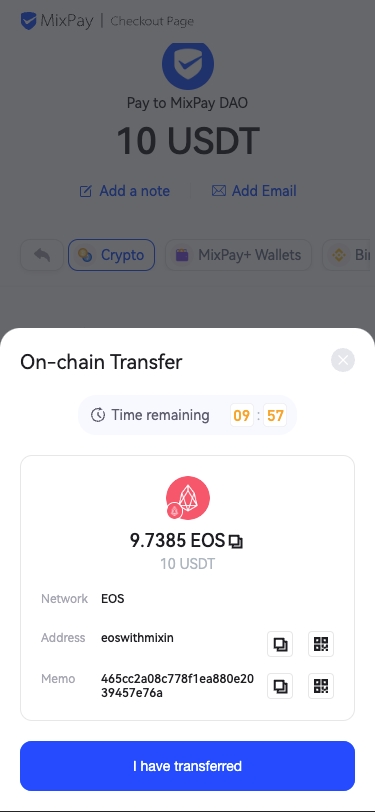
Note: If the payment assets are EOS, you can use the
taganddestinationfrom the API result.
Expiration
Raw API responses expose two different time concepts:
| Field | Meaning |
|---|---|
expire / seconds | Current quote or payment-address refresh window. A refreshed instruction can change paymentAmount or payment details. |
payments_result.expiredAt | Fixed payment deadline of the overall order. A refresh does not extend it. |
expiredTimestamp sets an absolute upper bound for the payment deadline. Omitting it does not make the payment valid indefinitely because MixPay and the selected payment method can impose earlier limits. Proxy-payment methods, including BTC Lightning, have a maximum effective payment window of 60 minutes.
Transactions first recognized after the payment deadline cannot complete the original order. If the full amount is recognized before that deadline, blockchain confirmation may continue after expiredAt until MixPay's separate confirmation deadline.
When the quote or address refresh window ends, request the latest payment information only while the order remains non-terminal. Do not reuse a traceId after success or failed, and never assume that a refreshed quote extends the overall order deadline.
Late or invalid payments can require an automatic refund or manual review depending on the payment method and failure reason. A failed payment result is not proof that a refund has completed.
Getting the result
It's recommended to implement the Payment Callback flow, for better performance.
Poll the Payment Result API from your server using traceId, or use orderId together with payeeId.
Tip: Poll the Payment Result API can easily hit our API rate limit. For better performance and stable use, always using the Payment Callback flow.
Only success and failed are terminal. Keep unpaid, confirming, paid_less, pending, and auditing open. Fulfill only after your server verifies a success result and the expected payee, quote asset, and amount.
Multi-payment (pay less)
If the user has underpaid, we can ask them to make an additional payment to complete the order. If you are using MixPay's Checkout Page, multiple payments are already handled, and you don't need to perform any additional actions. Simply check the data.status in the response to determine if it is equal to success.
However, if you are using the Raw API to build your own checkout page, you need to support multiple payments in order to improve the payments success rate.
To support multiple payments, you need to perform the following steps.
When calling the Payment Result API:
- Request
with=payment,transactions. - Use
data.status === "paid_less"as the primary underpayment signal. Integrations created beforepaid_lesswas introduced may retaindata.status === "pending" && data.payment.isFullyPaid === falseas a compatibility fallback. - Calculate
remainingAmount = max(data.payableAmount - data.paymentAmount, 0)using decimal-safe arithmetic. The top-levelpaymentAmountis the authoritative amount recognized for the order; do not derive it by summing unfiltered transaction rows. - Retrieve the latest payment instructions and ask the payer to send the remaining amount using the same payment asset, destination, merchant order, and
traceId. - Continue polling.
confirmingmeans recognized transactions still need confirmations;pendingmeans MixPay has accepted the payment as fully paid and the confirmation requirements are satisfied while order processing continues.
Do not create a new merchant order for the remaining amount. A refreshed instruction cannot extend payments_result.expiredAt, and a terminal trace cannot be refreshed into a new payment.
Q: If a user makes multiple payments exceeding the order amount, will the payment be successful?
A: An overpayment can still complete successfully. Check whether data.surplusAmount is greater than zero, then track data.surplusStatus (no, pending, sending, success, or expired) separately. Payment success does not mean that a surplus refund is complete.
Q: Can other payment methods (Mixin, Binance) support multiple payments? A: No. Only on-chain transfers support multiple payments.