Payment Link (Checkout Page)
You can use our MixPay payment page to create a MixPay payment. Payment link is the most convenient way of integrating MixPay.
We provide 3 types of payment links:
- Permanent Payment Link: This type of link can be customized and can be used for multiple payments. If you need to implement a long-term payment function, such as a donation, this type of link is a good choice. You can create a permanent payment link quickly in Dashboard Payment Link.
- One-time Payment Link: This type of link can only be used for a single payment. If you need to implement a one-time payment function, such as a bill, this type of link is a good choice.You can create a permanent payment link quickly in Dashboard Billing.
- Universal Payment Link: This type of link can achieve the functions of both permanent payment link and One-time payment link by customizing parameters, but the link cannot be personalized. If you need to implement a simple payment function, this type of link is a good choice.
Start with an example.
Here is an example of universal payment link, click the following button and check it out yourself:
IMPORTANT: The example is for new users to understand how the MixPay payment flow. We recommend using One-time Payment Link in the production.
Although this method is more convenient, and you may be more inclined to use this method of splicing parameters, you need to pay attention that when using this method, people can easily in the browser change the parameters you set.
Please checkout the Security Guidelines.
For better reference, the "Pay with crypto" button's link is:
https://mixpay.me/pay?payeeId=8e69e534-d0c4-3e04-8b61-37a73cd9e7d7
&settlementAssetId=c6d0c728-2624-429b-8e0d-d9d19b6592fa
"eAssetId=4d8c508b-91c5-375b-92b0-ee702ed2dac5
"eAmount=10
&orderId=your_order_id
&returnTo=https%3A%2F%2Fgoogle.com
When customers are on the checkout page, provide a "Pay with Crypto" button (with the above URL):
- When customers click the button, jump to our MixPay payment page;
- On our MixPay payment page, customers pay the crypto coin;
- After success, a non-iframe result page may navigate to
returnTo. Automatic navigation is conditional and is not proof of payment.
Parameters explain
Below is how to construct the URL parameters, according to the example URL above:
payeeId=8e69e534-d0c4-3e04-8b61-37a73cd9e7d7
settlementAssetId=c6d0c728-2624-429b-8e0d-d9d19b6592fa
quoteAssetId=4d8c508b-91c5-375b-92b0-ee702ed2dac5
quoteAmount=10
orderId=your_order_id
returnTo=https%3A%2F%2Fgoogle.com
payeeIdis the receiver ID in UUID format. Here is how you can see the UUID get-mixin-uuid API;settlementAssetIdis the specific coin will the payee wan to accept. You can see the supported asset id in Settlement Assets in UUID format.quoteAssetIdis the cryptocurrency in UUID format, and you can see the supported asset id in Quote Assets.quoteAmountis the total payment amount according to thequoteAssetId.orderId- Unique in your system. String lengths **between 6 and 36 must be letters, numbers, dashes, underscores, and NO space.orderIdandpayeeIdmake a payment unique.returnTois the preferred destination after a successful payment. Automatic navigation can be suppressed for iframe, surplus/refund, or merchant-controlled return flows and must not be used as a payment notification.
Special Parameters For Payment Link
There are several parameters here, used to specify the default behavior of the Checkout Page(both of permanent payment link, One-time payment link, and universal payment link).
amountis the total payment amount according to thequoteAssetId, and takes priority overquoteAmount.paymentAssetIdis used to specify the coin that the user wants to pay with, and you can see the supported asset id in Payment Assets in UUID format.paymentMethodis used to specify the payment type, which can becrypto,mixpayplus.paymentWalletis used to specify the payment wallet, which can begateio,binance.onlyShowWalletis used to only show a specific wallet channel. SettingonlyShowWallet=balancewill only show Binance Pay.payerEmailis used to specify the email address of the payer to receive the payment results.payerEmailmust be valid, or you can not create a payment.styleThe page is divided into Desktop template, Mobile Universal template, and Mobile Wallet template. Settingstyle=iframecan force to use the Mobile Universal template.
| template name | example |
|---|---|
| Desktop Template | 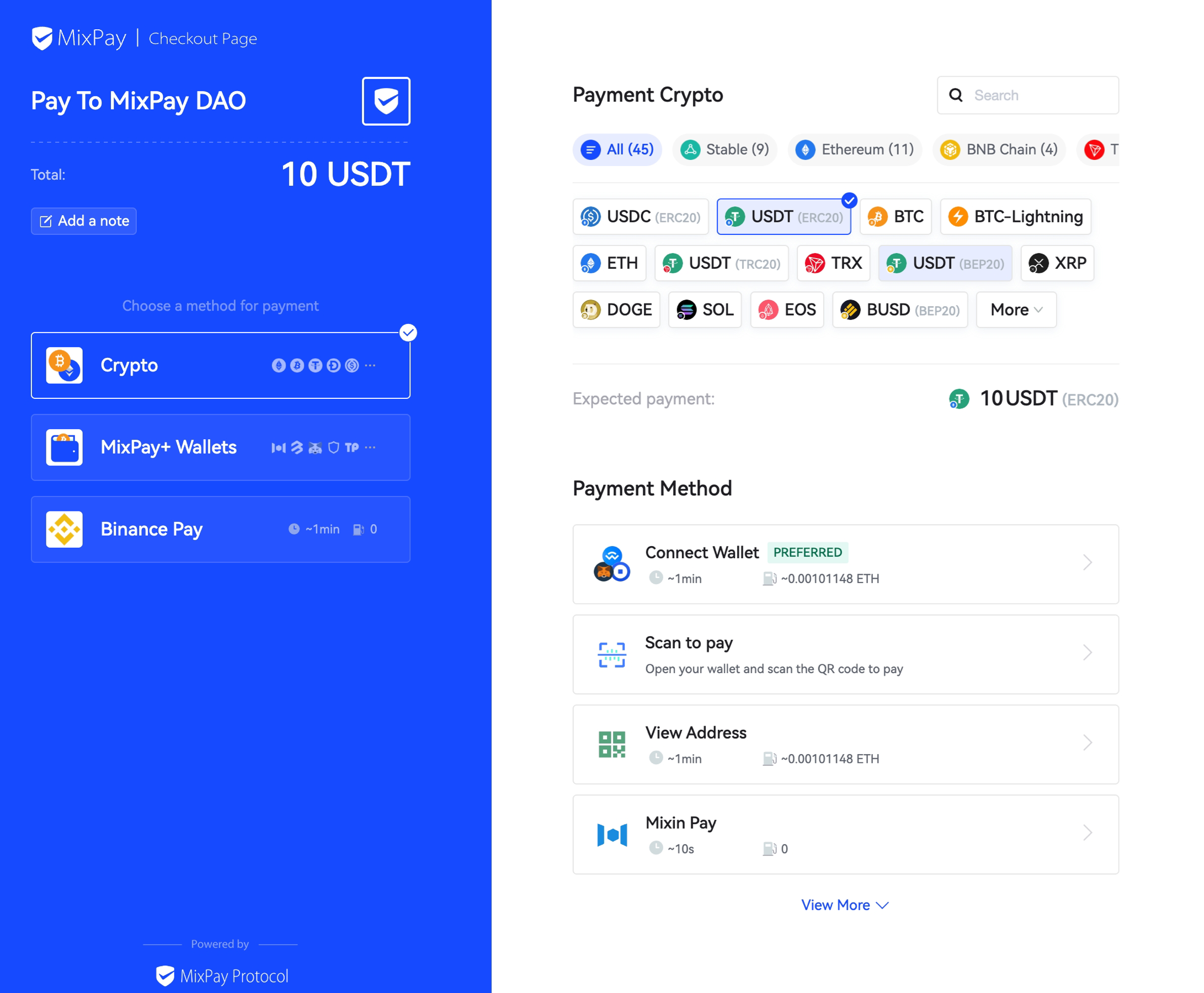 |
Mobile Universal Template(iframe) | 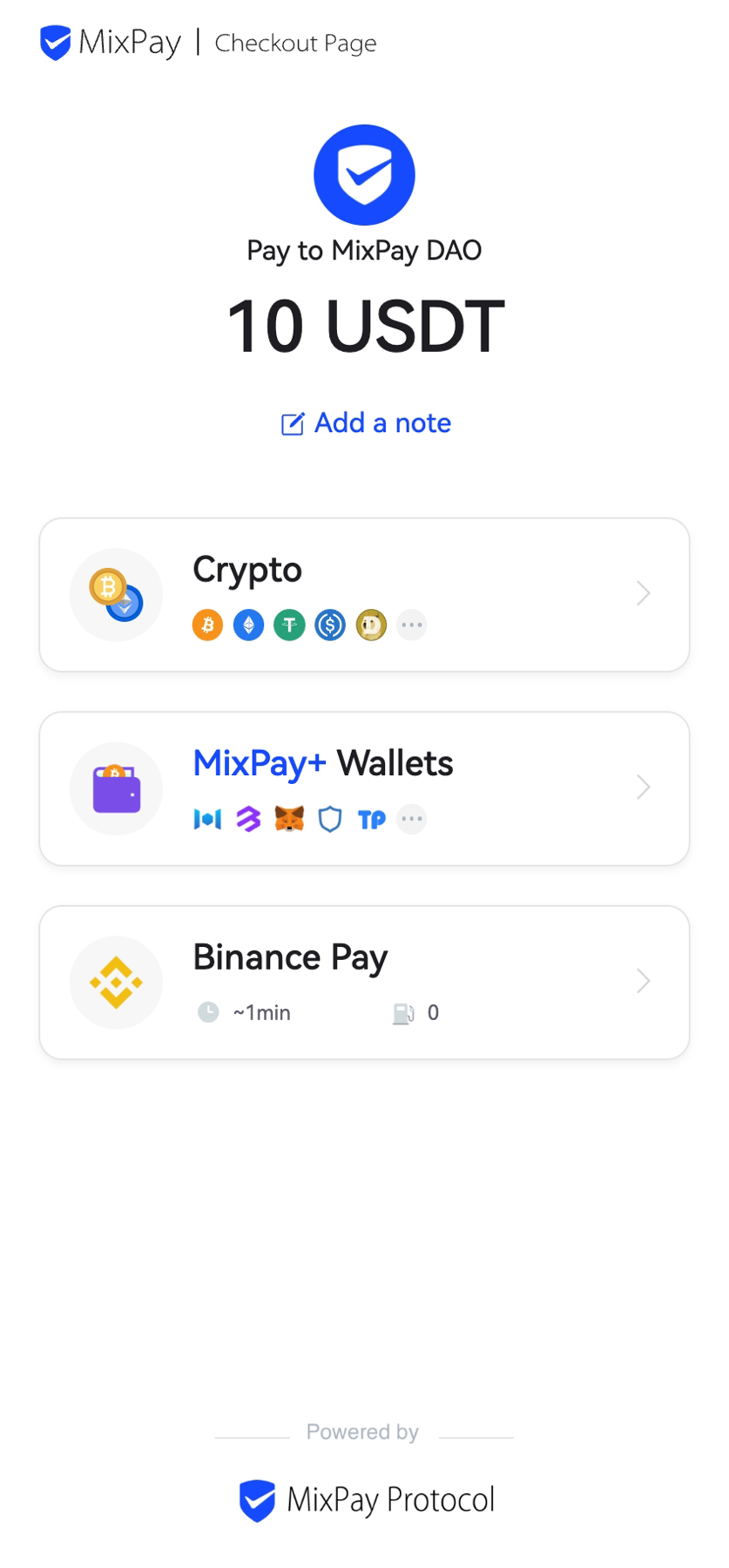 |
| Mobile Wallet Template | 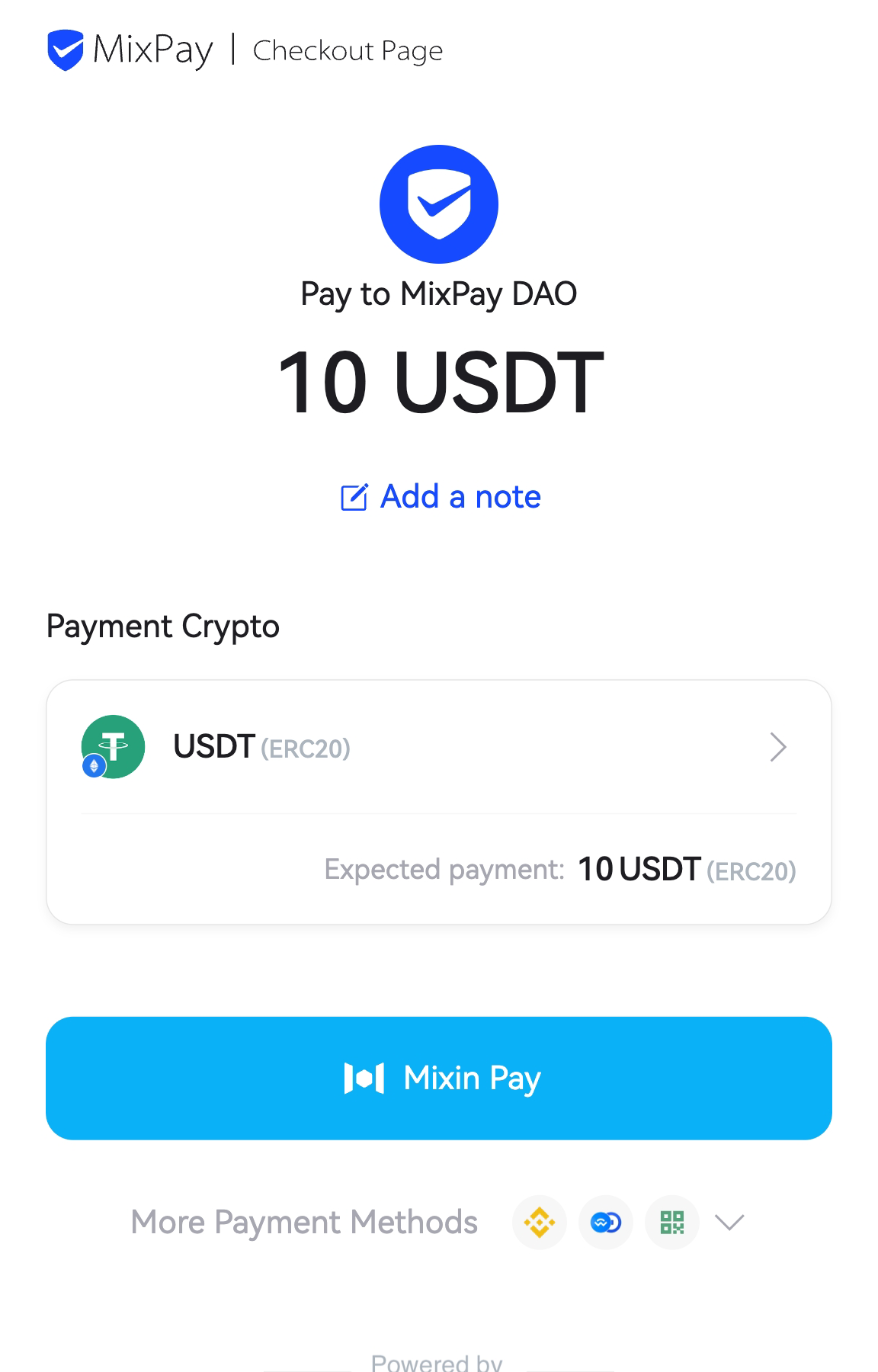 |
Embedding the Payment Link
Set style=iframe to embed the hosted checkout. The result page sends UI notifications to its top-level parent with this shape:
{
  "type": "MIXPAY_PAYMENT",
  "data": {
    "traceId": "39878c67-a749-4e2f-a495-743d139db9f2",
    "clientId": "bb5bdb53-075e-4b40-a6cc-1d81b8c2f78d",
    "status": "confirming"
  }
}
Treat the message as a checkout UI notification, not as an authoritative or guaranteed delivery channel. Validate both event.origin and event.source, then query payments_result from your server before fulfillment.
<iframe
id="mixpay-checkout"
src="https://mixpay.me/pay?payeeId=8e69e534-d0c4-3e04-8b61-37a73cd9e7d7&style=iframe&settlementAssetId=c6d0c728-2624-429b-8e0d-d9d19b6592fa"eAssetId=4d8c508b-91c5-375b-92b0-ee702ed2dac5"eAmount=10&orderId=your_order_id"
style="width:100%;height:100%;border:none"
></iframe>
<script>
const checkoutFrame = document.querySelector('#mixpay-checkout');
const expectedOrigin = new URL(checkoutFrame.src).origin;
window.addEventListener('message', async function (event) {
if (event.source !== checkoutFrame.contentWindow) return;
if (event.origin !== expectedOrigin) return;
if (!event.data || event.data.type !== 'MIXPAY_PAYMENT') return;
const snapshot = event.data.data;
// Send snapshot.traceId to your server. Your server must query
// GET /v1/payments_result and verify the stored order fields.
const result = await getVerifiedResultFromYourServer(snapshot.traceId);
if (result.status === 'success') {
completeCheckoutOnce(result);
} else if (result.status === 'failed') {
showPaymentFailure(result.failureCode, result.failureReason);
} else if (result.status === 'paid_less') {
showTopUpProgress(result);
} else {
showPaymentInProgress(result.status);
}
});
</script>
unpaid, confirming, paid_less, pending, and auditing are non-terminal. When an iframe order is underpaid, the hosted flow may navigate the iframe back to the payment page so the payer can send the remaining amount. Keep the original merchant order, traceId, and existing clientId channel, but use only the latest payment asset, amount, destination, and Tag/Memo returned by the refreshed payment information.
When style=iframe is used, the hosted page does not automatically redirect the top-level merchant page after success. The parent page is responsible for its own navigation. Do not rely on iframe message frequency, ordering, or continued delivery.
Getting the result
Configure a Payment Callback for prompt server notification, and keep server-side polling as a fallback. In both cases, query GET /payments_result and fulfill only after verifying an authoritative success result. See Payment Lifecycle.